
What this view helps you inspect
Use this view when the question is how comparable strikes differ between expiries. The central strike ladder is shared, while each expiry has its own premium and participation. The nearest expiry sits closest to the strike. Only contracts supplied for the chosen underlying can be selected; the tool name does not imply that every index has active weekly expiries.
The header’s DTE and ATM-straddle value provide context for the selected expiry. More time remaining naturally affects premium, so raw prices are not a clean measure of relative cheapness. Intraday and EOD price changes use different references; choose one before comparing the columns.
Screenshot: controls and measurements
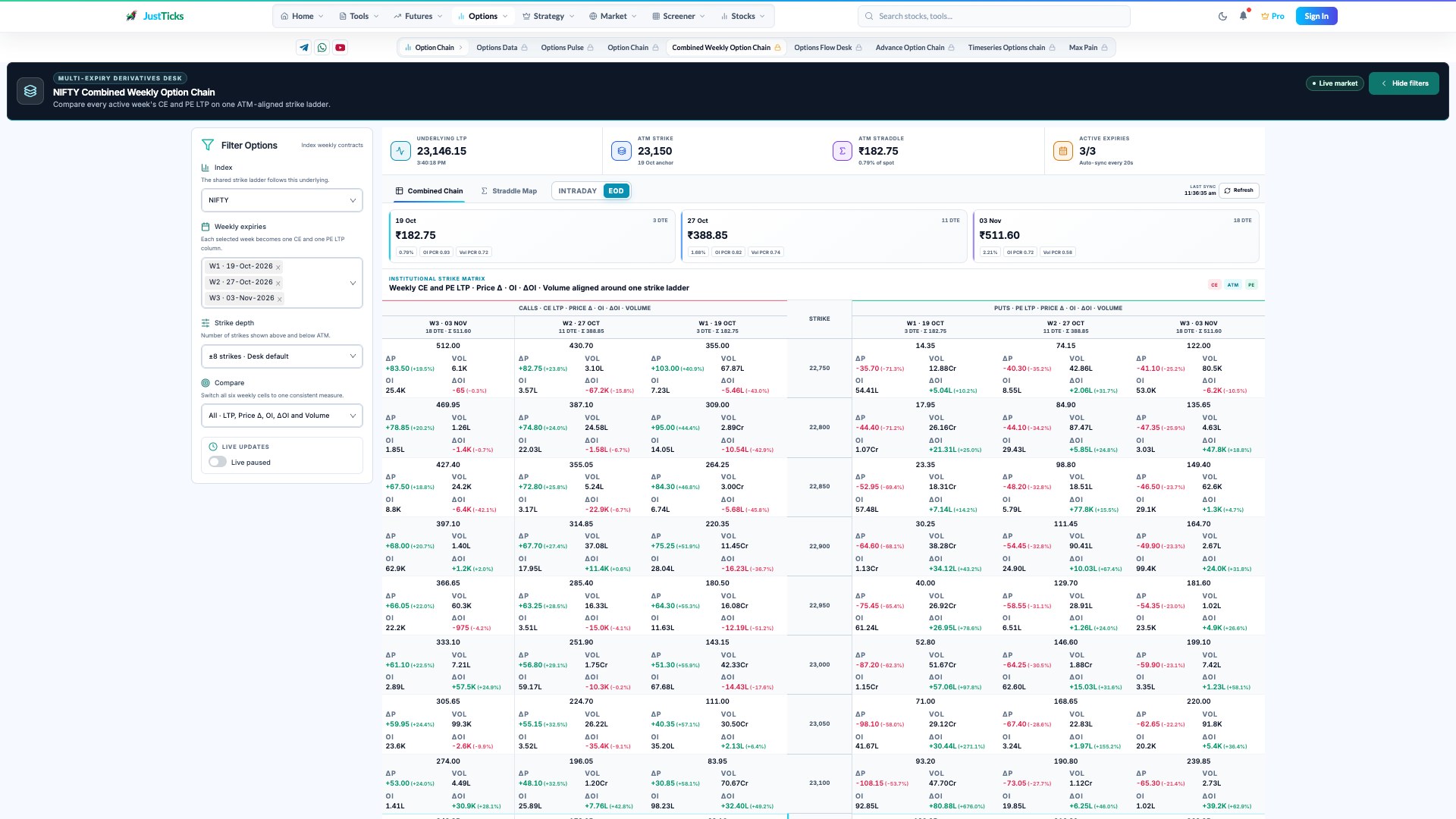
- Select available expiries. Each selected expiry contributes a call and a put comparison.
- Use the shared strike ladder. Hold the strike constant while comparing expiry columns.
- Inspect expiry summaries. Expiry-specific straddle and participation summaries describe different contracts.
- Keep one comparison measure. Choose premium, change, OI or volume consistently.
Read the fields before the colours
| Field | How to read it |
|---|---|
| Expiry column | The expiry date and CE/PE side identify a distinct contract at each strike. |
| DTE | Time remaining to that expiry, as displayed in the header. |
| LTP | Last traded premium for the particular expiry and strike. |
| Price change | Difference from the selected Intraday or EOD reference. |
| OI and OI change | Outstanding quantity and its change for that expiry; these are not interchangeable with volume. |
| ATM straddle (Σ) | The displayed sum of call and put premium at the expiry’s ATM reference. |
How to use the tool step by step
- Choose the underlying index and review the available expiry dates. Do not assume availability from an old screenshot.
- Select the expiries you want to compare. Each selected expiry adds one call and one put column.
- Choose a strike depth around ATM. Start with a small range so headers and the central strike remain readable.
- Set one Compare measure, or use All while learning the field positions. Keep the Intraday/EOD change reference fixed.
- Hold a strike constant as you compare expiries. Check DTE and participation beside the premium.
- Inspect ATM straddle values and then the actual legs. Open a strategy tool to study a multi-expiry position’s payoff assumptions.
Worked example: keep the measurements separate
Suppose a call at one strike costs 100 in the near expiry and 160 in a later expiry. The difference is 60 premium points, but the later contract also carries more time and potentially a different event exposure. Subtracting the prices is not enough to conclude that a calendar spread is attractive. Verify the paired put, DTE, quote freshness, volume and transaction costs, then model the intended position separately.
Limits and common interpretation mistakes
A zero, blank or unchanged LTP can reflect missing or stale trading rather than a free option. Align observation times as closely as possible. Differences in expiry, moneyness, event exposure and liquidity affect comparisons. The table is a comparison of contracts, not an executable spread quote or a model of a multi-expiry strategy’s full risk.