
The four Greeks at a glance
| Greek | Measures | Largest when | Sign |
|---|---|---|---|
| Delta | Change in premium for a one-point move in the index | The option is deep in the money | Calls positive, puts negative |
| Gamma | Change in delta for a one-point move in the index | At the money and close to expiry | Positive for bought options |
| Theta | Premium lost to the passage of one day | At the money, accelerating into expiry | Negative for bought options |
| Vega | Change in premium for a one-point change in IV | At the money with more time to expiry | Positive for bought options |
Rho, the sensitivity to interest rates, exists but is small for the short-dated options most Indian traders use.
Delta: how far the premium follows the index
A call with a delta of 0.50 is expected to gain about half a point of premium for each point the index rises, all else equal. At-the-money options sit near 0.50 in absolute terms, in-the-money options approach 1.00 and far out-of-the-money options approach zero. Delta is also read as a rough, model-based probability of finishing in the money, though that reading is only approximate.
Gamma: how fast delta itself changes
Gamma is the acceleration. When gamma is high, a small index move changes delta a lot, so the premium speeds up or slows down quickly. At-the-money gamma rises sharply as expiry approaches, which is why short-dated premiums can jump on expiry day. The gamma guide covers this in detail.
Theta: the cost of waiting
Theta is the premium that disappears with time when nothing else changes. It is concentrated in at-the-money options and speeds up as expiry nears. Theta is a model estimate, not a guaranteed daily debit or credit: a favourable price or IV move can outweigh it.
Vega: the reaction to implied volatility
Vega tells you how much premium changes for a one-point move in implied volatility. It is highest for at-the-money options with more time left, and it shrinks toward expiry. A rise in IV adds to the premium of both calls and puts, which is why a straddle can gain when IV expands even if the index goes nowhere. See the vega guide and the implied volatility guide.
How the Greeks move together
On any given candle the premium change is the sum of several effects: delta times the index move, a gamma adjustment on top of it, theta for the time that passed and vega times any change in IV. That is why a call can lose value on a day the index rises slightly, if IV falls or time decay dominates.
- Index up, IV down: delta helps the call, vega hurts it.
- Index flat, time passing: theta quietly reduces premium.
- Expiry day: gamma and theta are both large, so premiums swing fast in both directions.
Tracking Greek changes by strike
Static Greeks show one snapshot. The Greeks Change tracker on JustTicks compares each snapshot with the previous one, so you can see which strikes are gaining or losing delta, gamma, theta or vega as the session unfolds. Pick the Greeks and sides, centre the strike window on the at-the-money strike, read the change charts for shape and confirm exact values in the latest-change table. Put-side changes are shown with the sign flipped so calls and puts sit on one scale.
Which Greeks tool answers your question?
| Your question | Open | Important difference |
|---|---|---|
| How did a Greek change between snapshots? | Greeks Change tracker | Change in sensitivity, not the option's premium change |
| Where is gamma concentrated by strike? | Gamma Analysis | Option sensitivity before OI and quantity weighting |
| Where is modeled gamma exposure concentrated? | Nifty GEX | Gamma weighted by positioning inputs and a sign convention |
| How sensitive are premiums to IV? | Vega Analysis | Vega measures IV sensitivity; it does not predict an IV change |
| How is IV changing? | Implied Volatility chart | IV is a pricing input rather than a Greek |
| How does my whole position respond? | Strategy Builder | Position Greeks depend on action, quantity and all legs together |
- Vanna and volatility trigger: IV-induced delta sensitivity and the modeled gamma crossing.
- IV screening, historical IV and the market dashboard: discover, verify and summarize volatility.
- IV shock simulation and the surface monitor: conditional stress versus the observed smile and term structure.
- GEX screening: compare modeled regime and level context before opening an individual profile.
For a contract-level activity screen, read the OTM unusual-activity guide. A volume burst is different from a change in option sensitivity and does not identify who initiated the trade.
How to use the Greeks Change tracker
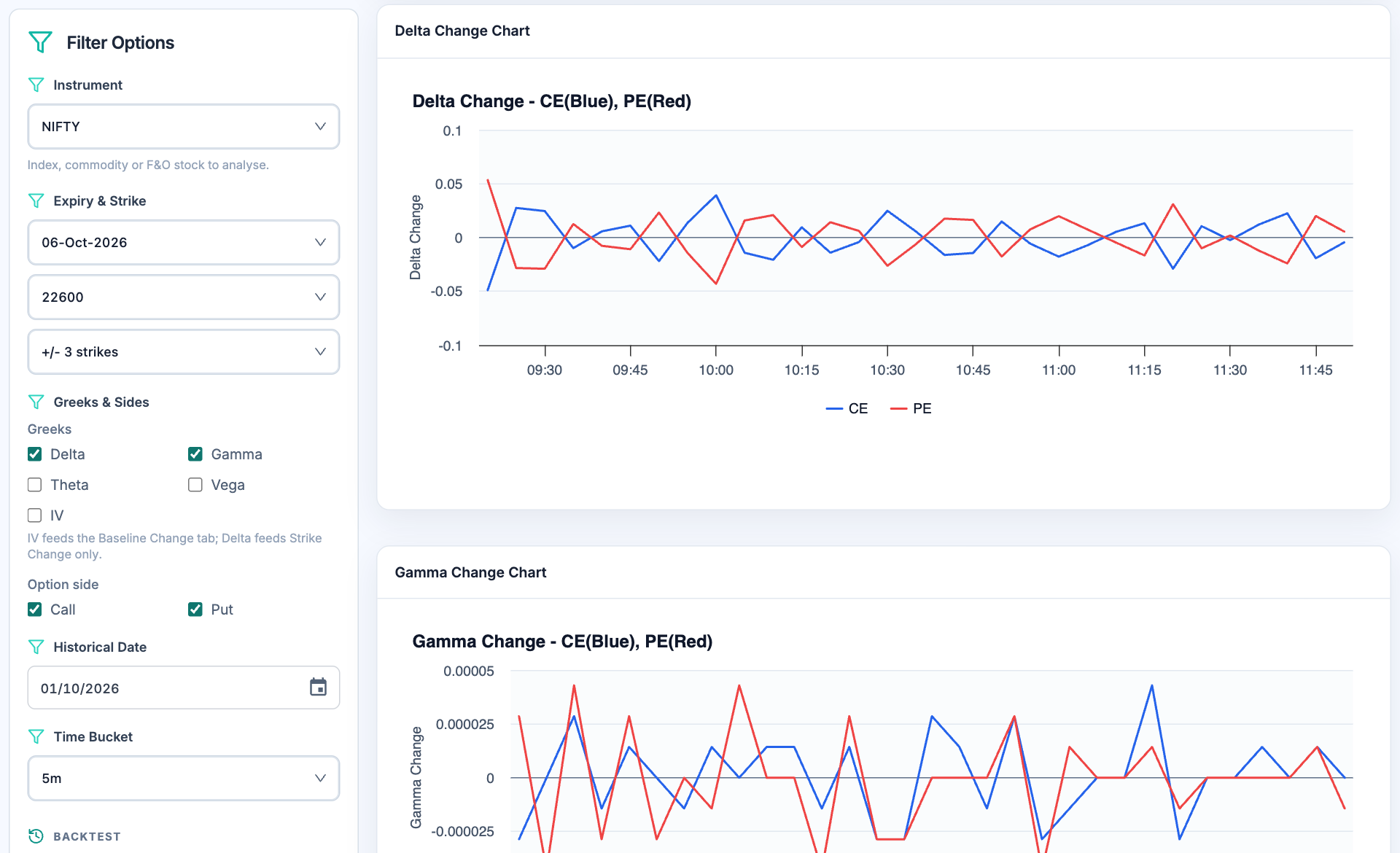
- Strike window. This defines which contracts are included around the selected center strike.
- Greek selection. Start with one sensitivity and read its units before enabling another.
- Call and put sides. CE and PE can be compared separately. Read the sign convention for the selected change view.
- Delta change. The line describes a change in sensitivity; it is not the option premium or the underlying return.
- Select the instrument, expiry and session. Keep these fixed when comparing two charts.
- Choose a center strike and the number of strikes on each side. This defines the contracts in the comparison.
- Select a Greek and CE or PE. Start with one sensitivity so its units and sign convention are clear.
- Choose the time bucket. Strike Change compares snapshots; Baseline Change compares eligible metrics with the session baseline.
- Verify a plotted change in the latest table and check its timestamp. In the strike-change comparison, put-side changes are sign-adjusted; read the label before interpreting the sign.
A positive gamma change means gamma increased under the displayed convention. It does not mean that the underlying must rise. To understand exposure weighting and its assumptions, read the GEX guide.
Limits and common misreads
- Model values. Greeks are calculated from a pricing model and the IV it uses, so different platforms show slightly different numbers.
- Per-unit, not per-lot. Greeks are quoted per unit of the underlying; multiply by lot size to think in rupees.
- A positive change is not bullish. A rising Greek describes sensitivity, not a market view.
- Thin strikes. Greeks for strikes that rarely trade rest on stale IV.
This guide is educational and is not investment advice.
Further reading
OCC's Options Industry Council: understanding Greeks. The JustTicks walkthrough describes this site's controls, which may differ from other platforms.