
Separate the structure concepts
| Term | Question it answers |
|---|---|
| BOS | Did price break a reference swing in the existing structure direction? |
| CHoCH | Did the modeled structure switch direction relative to the prior impulse? |
| Order block | Which model-defined price zone is attached to the structure? |
| Breaker | Has a previously defined zone changed state under the rules? |
| Liquidity label | What did price do around a reference extreme? |
The definitions depend on swing lookback and freshness settings. Changing those settings can change both the latest label and the zone boundaries.
Filter and verify a structure event
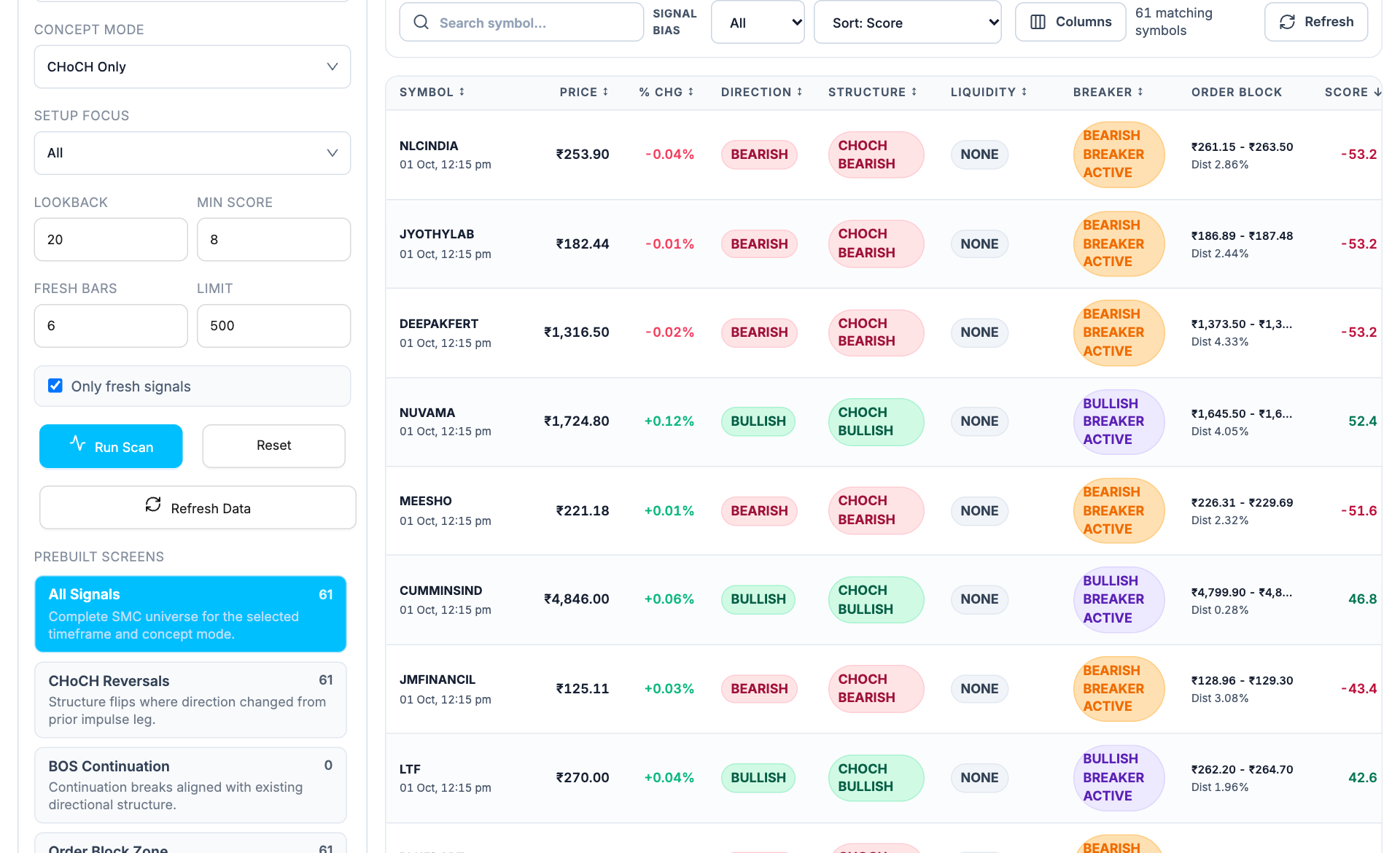
- Choose concept mode. CHoCH Only narrows to structure changes instead of all signals.
- Set lookback and freshness. Lookback builds references; fresh bars limits event age.
- Read the structure label. Direction and CHoCH/BOS refer to the model event.
- Inspect the zone. Read exact price boundaries and distance before checking the chart.
- Choose timeframe, universe and concept mode.
- Set lookback, minimum score and freshness window, then run the scan.
- Compare direction, structure, breaker and liquidity columns without assuming they are equivalent.
- Open a row and locate the reference swing and model zone on the chart.
- Review whether later price invalidated the zone or changed the structure label.
CHoCH is a transition, not a forecast
Suppose the reference structure is rising but price closes below the last selected swing low. The model can label a bearish CHoCH. A later reclaim of that level is new evidence; the original event does not guarantee a continuing decline.
Model boundaries
- Swing confirmation can require later candles; a chart viewed later can contain more context than was available at the event.
- OHLCV zones do not reveal resting orders or participant identity.
- Small lookbacks produce more transitions and can amplify noise.
- A score compares rule alignment; it is not a measured success rate.