
Read the diagnostics separately
| Field | Question it answers | Limit |
|---|---|---|
| Bollinger Z-score | How far price is from its recent mean in standard-deviation units? | A trend can remain stretched |
| OU Z / fair value | How far price is from the fitted mean-reverting process? | Sensitive to model fit and window |
| Half-life | How quickly does the fitted deviation decay? | An estimate, not a countdown |
| Hurst exponent | What persistence regime does this sample suggest? | Noisy and window dependent |
| RSI / Connors RSI | How extended is recent directional behavior? | An extreme alone does not establish reversal |
Use the reversion research list
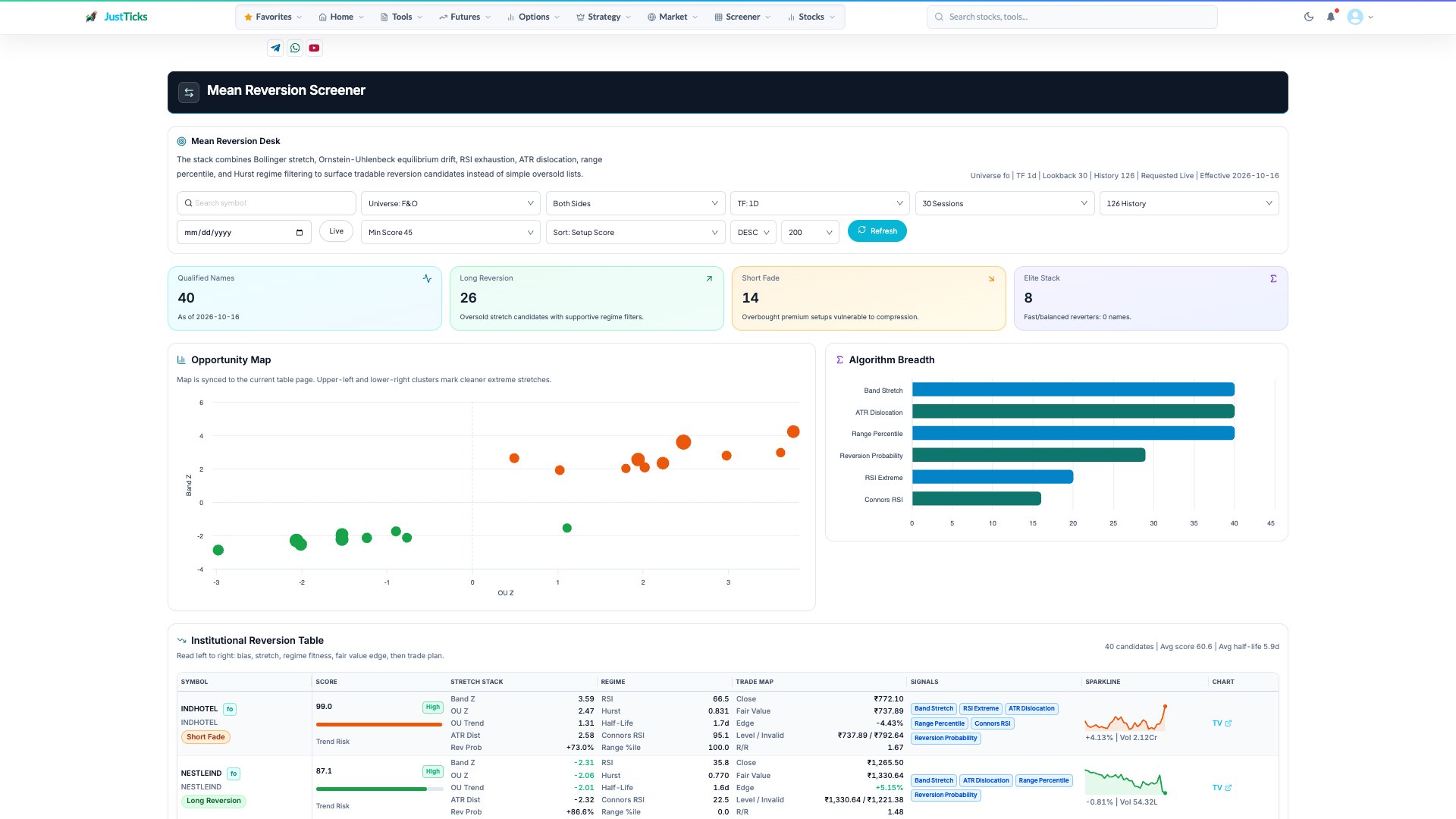
- Timeframe and history. Choose the observation interval, lookback and history length together.
- Opportunity map. Band and equilibrium deviations are model coordinates, not predicted returns.
- Algorithm breadth. Check which filters contribute to the available candidate set.
- Regime and trade map. Read regime fitness alongside the stretch measures before interpreting a candidate.
- Open the Mean Reversion Screener, choose universe and timeframe.
- Choose the fitting window and available history before comparing model outputs.
- Select Long Reversion or Short Fade to narrow the model direction.
- Sort by setup score or one diagnostic, then inspect whether the other diagnostics agree.
- Open a candidate chart, compare the fitted reference with trend and current price, and check whether the latest candle is complete.
A Z-score is not a return forecast
If a reference mean is 100, its estimated standard deviation is 2 and price is 96, the simple Z-score is (96 − 100) ÷ 2 = −2. That says price is two estimated standard deviations below this reference. It does not mean price must rise four points or that a two-standard-deviation event has a fixed probability in market data.
The model can be wrong about the regime
- Structural repricing can move the reference mean rather than bring price back to it.
- An event or results announcement can invalidate a historical fit.
- Half-life and any reversion-probability field are model estimates, not validated execution outcomes.
- Small samples and illiquid series can make estimated statistics unstable.
- The selected fitting window must be the same when comparing candidates.