
What is vanna?
Vanna measures how an option's delta changes when implied volatility changes. Equivalently, it shows how vega changes when the index moves. It is called a cross-Greek because it ties the index and volatility together.
Why it matters: option hedgers keep their delta close to neutral. If IV jumps, the delta of out-of-the-money options shifts, so hedgers must buy or sell the underlying to stay balanced. That rebalancing is the flow vanna describes.
Vanna exposure (VEX)
Vanna exposure aggregates the vanna of every strike, weighted by open interest and contract size, and applies an assumed volatility shock to estimate the size of the potential hedging flow in rupees. Large positive or negative VEX at a strike means that strike is more sensitive to an IV repricing.
Like every positioning-based model, VEX relies on assumptions about who holds the contracts, so different providers and sign conventions give different values. Read it as structure, not as a standalone signal.
Read OI Basis on the tool. When open interest is already expressed as underlying quantity, the displayed model does not apply another lot multiplier. Mixing lots, contracts and underlying quantity can produce very different absolute exposure values.
Screenshot: model inputs and the vanna profile
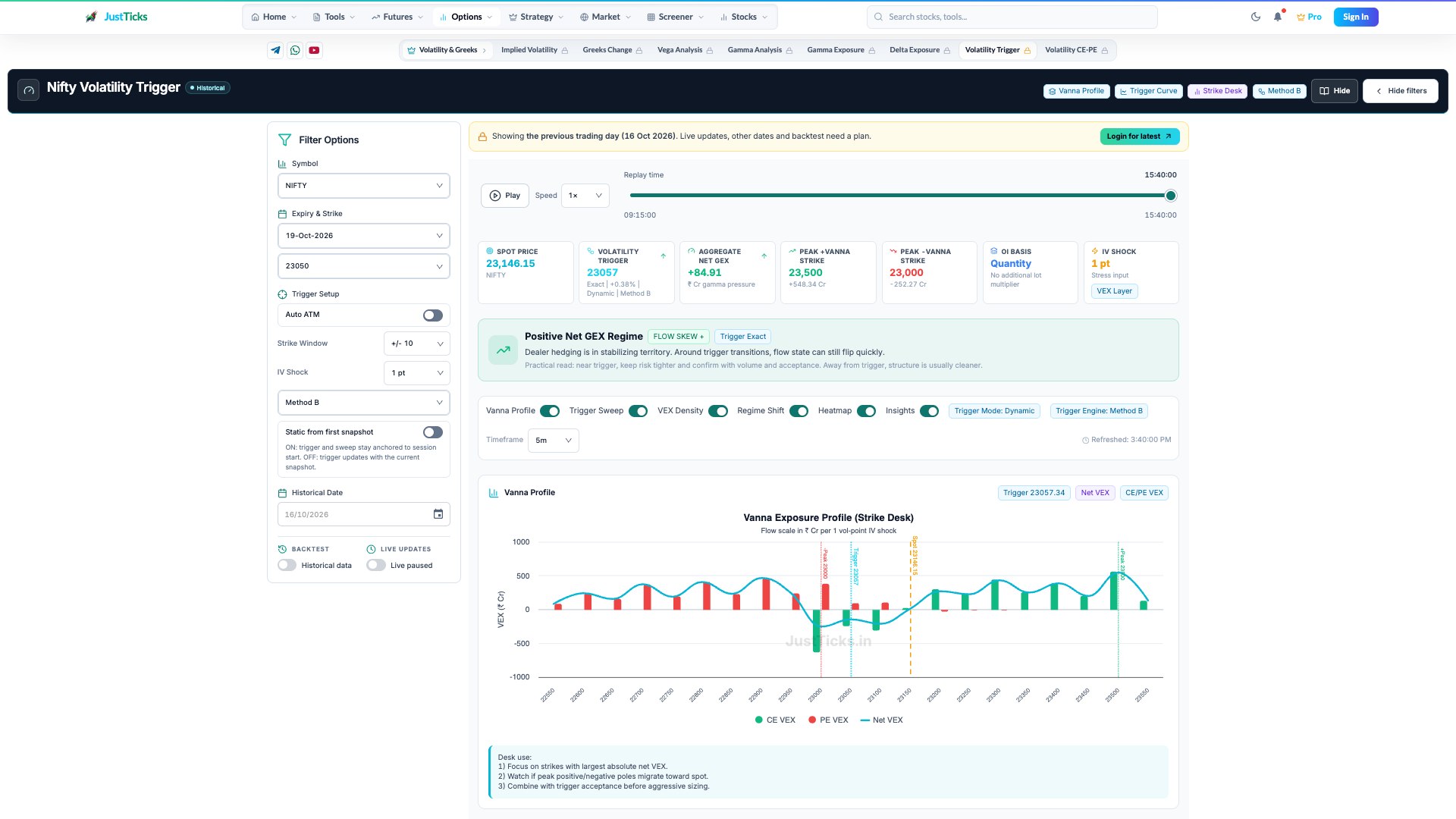
- Contract selection. Confirm the expiry and reference strike before reading the profile or sweep.
- IV shock. The assumed IV change is a model input, not an observed future move. Compare it with the selected method and strike window.
- OI basis. The pictured model uses quantity, with no additional lot multiplier. Check units before comparing absolute exposure across providers.
- Strike profile. Read CE, PE and net VEX with the legend. Poles and the trigger are model references, not observed dealer positions or a guaranteed price direction.
IV shocks and hedging flow
- An IV increase and an IV decrease apply shocks with opposite signs to the same covered vanna profile.
- The modeled direction and size depend on net vanna, open interest, quantity, units and the assumed positioning convention.
- An IV rise does not universally create instability and an IV fall does not universally calm price. Read the model output under both scenarios.
Compare shocks at the same snapshot and scope. Neither the scenario nor the modeled flow identifies actual dealer holdings.
What the volatility trigger marks
On the JustTicks page the volatility trigger is an estimated underlying level where net gamma exposure crosses zero, also called the gamma flip. Read the sign on each side of the actual sweep; positive or negative exposure cannot be assigned universally to above or below the crossing. The page offers three calculation methods so you can compare the sensitivity of the estimated crossing.
The trigger is a regime line, not a trade signal. Crossing it says the hedging behaviour may change, not that price will move in a given direction. Vanna exposure is shown alongside as the IV-shock overlay, so you can see where a volatility repricing would matter most relative to the trigger.
Terminology varies: some providers use "volatility trigger" for a level derived from the distribution of gamma rather than a simple zero-cross, so compare definitions before comparing numbers across platforms.
Reading the Volatility Trigger page
- Vanna profile: net VEX by strike; the largest positive and negative bars are the structural poles.
- Trigger sweep: net gamma against index level, with the zero-cross marked.
- VEX density: all strikes, to find clusters rather than only the selected window.
- Regime shift: spot, trigger and aggregate net gamma through the session.
- Strike desk: the top strikes by absolute net VEX with IV, open interest and distance from spot.
Set up the volatility-trigger workspace
- Choose instrument, expiry, session and strike window. Confirm the snapshot time and OI basis.
- Select an IV shock in volatility points and compare the same scope under the opposite shock. A shock is an assumption, not a forecast.
- Choose a trigger method, then read its sweep and reported crossing. Check the sign on each side instead of assuming that above always means positive.
- Compare Dynamic with Static from first snapshot deliberately: static keeps the session-start reference, while dynamic recomputes as the covered chain changes.
- Use the profile and strike desk to identify concentrated vanna sensitivity. Use the regime timeline and heatmap to inspect persistence rather than interpreting one frame as known dealer orders.
Limits and common misreads
- Modelled positioning. Holders are assumed, so the sign convention can invert the picture.
- Data quality. Stale IV on untraded strikes and thin open interest distort VEX.
- The trigger moves. IV, open interest, spot and time all shift it during the session.
- Not a forecast. Neither the trigger nor VEX predicts direction.
This guide is educational and is not investment advice.