
What gamma measures
Delta tells you how much a premium moves for a one-point index move. Gamma tells you how much delta changes for that same move. If an at-the-money call has a delta of 0.50 and a gamma of 0.002, a 100-point rise lifts the delta to roughly 0.70, so the premium speeds up as the index climbs. Gamma is highest for options near the money and small for deep in-the-money or far out-of-the-money options.
Why gamma rises into expiry
As expiry approaches, the outcome of an at-the-money option becomes a near coin-flip that a tiny move can resolve, so delta swings from low to high over a very small range of index levels. That is a high gamma. The same option a month before expiry changes delta gradually over a wide range, which is a low gamma.
| Time to expiry | At-the-money gamma | What it feels like |
|---|---|---|
| Weeks | Low | Premium follows the index smoothly |
| A few days | Rising | Delta changes noticeably across a session |
| Expiry day | Very high at the money | Premium can jump or collapse within minutes |
Gamma vs gamma exposure (GEX)
Gamma analysis looks at the gamma of the options themselves, by strike, for calls and for puts. Gamma exposure weights that gamma by open interest and contract size to estimate how large the hedging flow could be, then nets calls against puts under an assumption about who is on the other side. The gamma exposure guide explains walls, the flip level and regimes.
Use gamma analysis to see which strikes are most sensitive right now and how that is changing, and GEX to see where modelled hedging pressure is concentrated.
Reading the gamma analysis chart
- Centre the strike window on the at-the-money strike and keep the strike count fixed when comparing sessions.
- Compare call gamma and put gamma to see whether sensitivity is balanced.
- Switch to the percentage-change view to see how gamma is evolving, remembering that small starting values exaggerate percentages.
- Replay the session with the timeframe you prefer to see when gamma built up.
How to use the Gamma Analysis
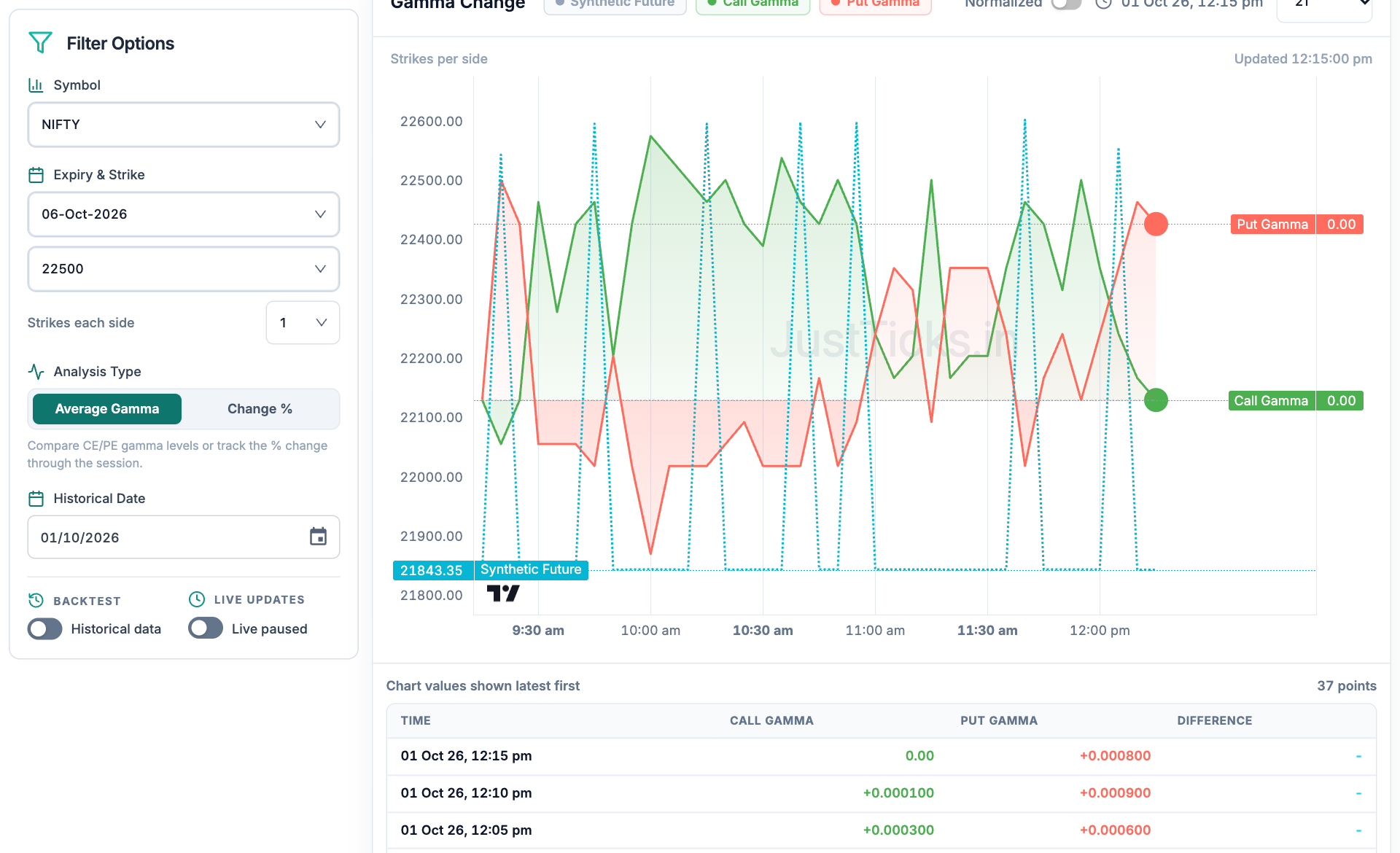
- Expiry and center strike. Gamma comparisons need the same expiry, contract and observation time.
- Average versus change. Read the selected analysis and chart label before interpreting a value.
- Rounded chart value. Small gamma values can round to 0.00 on a label. Inspect the detailed table.
- Detailed precision. The strike table preserves more digits than the plot label.
- Choose instrument, expiry, center strike and the number of strikes per side.
- Inspect the gamma level before the change view. Confirm normalization and timeframe before comparing another session.
- Read the detailed table when small values round to zero on the chart.
- Compare with GEX only after checking OI weighting, quantity, units and the assumed positioning sign.
Limits and common misreads
- High gamma is not direction. It says the premium is highly responsive, not which way the index will go.
- It is a model estimate that depends on the IV and time to expiry used.
- Gamma shifts with the index. As Nifty moves, the highest-gamma strike moves with it.
- Percentage changes spike when the earlier gamma was close to zero.
This guide is educational and is not investment advice.