
What is implied volatility?
Implied volatility is the volatility figure that, when fed into an option pricing model together with the strike, expiry and underlying price, reproduces the premium the market is actually paying. It is quoted as an annualised percentage. A higher IV means the market is pricing larger possible moves; a lower IV means smaller ones.
IV is not a forecast of direction and not a measurement of how much the index has moved. It is an input that is backed out of live prices, so it changes whenever demand for options changes, even when the index itself is flat.
India VIX vs the IV of a Nifty option
India VIX is published by NSE and is computed from Nifty option prices. It summarises the volatility the market expects over roughly the next 30 days, so it blends the near and next expiries into one number.
The IV on an option chain is different: it belongs to one strike and one expiry. A weekly at-the-money option can show an IV well above or below India VIX, especially in the days before a known event, because short-dated options react to near-term risk first. There is also no single official "IV of Nifty"; at-the-money IV depends on which strikes you average and which expiry you pick.
IV rank and IV percentile
A raw IV of 14% means little without history, because 14% is high for one instrument and low for another. IV rank and IV percentile answer "high compared with what?"
| Measure | What it tells you | Watch out for |
|---|---|---|
| IV rank | Where the current IV sits between the lowest and highest IV of the look-back window | One spike earlier in the window stretches the range and pushes the rank down for months |
| IV percentile | The share of sessions in the window that had a lower IV than today | Less sensitive to a single spike, but still depends on the window length |
Use both, and keep the window the same when you compare two instruments. A high rank says options are expensive relative to their own past; it does not say they are overpriced for the risk ahead.
Call IV, put IV and skew
Calls and puts at the same strike and expiry should carry similar IV under textbook assumptions, yet live chains show a gap. The gap is called skew. Index puts often trade at a higher IV than calls because of demand for downside protection, so a put-over-call gap is common; a call-over-put gap points to unusual demand for upside.
The IV chart plots call and put IV side by side so you can see whether the gap is stable through the session or widening into an event.
IV across expiries and events
Comparing the same strike across weekly and monthly expiries shows the term structure. If the near expiry sits above the next one, the market is paying up for something that happens soon, such as an RBI policy decision, results or expiry-day positioning. Once the event passes, IV often falls even when the index barely moves, which is why traders talk about an IV crush.
- Scheduled events: policy announcements, results and budgets lift near-dated IV before they happen.
- Demand shocks: a sharp fall in the index tends to lift IV, because protection is bought.
- Expiry mechanics: short-dated IV can move quickly on expiry day because small price changes matter more to premium.
Reading the IV chart on JustTicks
The chart shows call IV and put IV for the strike you select, with the index price behind it so you can separate volatility moves from price moves. A volume-weighted IV line and running averages smooth noise, and the replay control steps through any past session at the timeframe you choose.
Start at the at-the-money strike, switch between the average IV view and the IV change view, then widen the strike window to see whether the move is broad or limited to one strike.
Use the IV chart: levels, changes and historical sessions
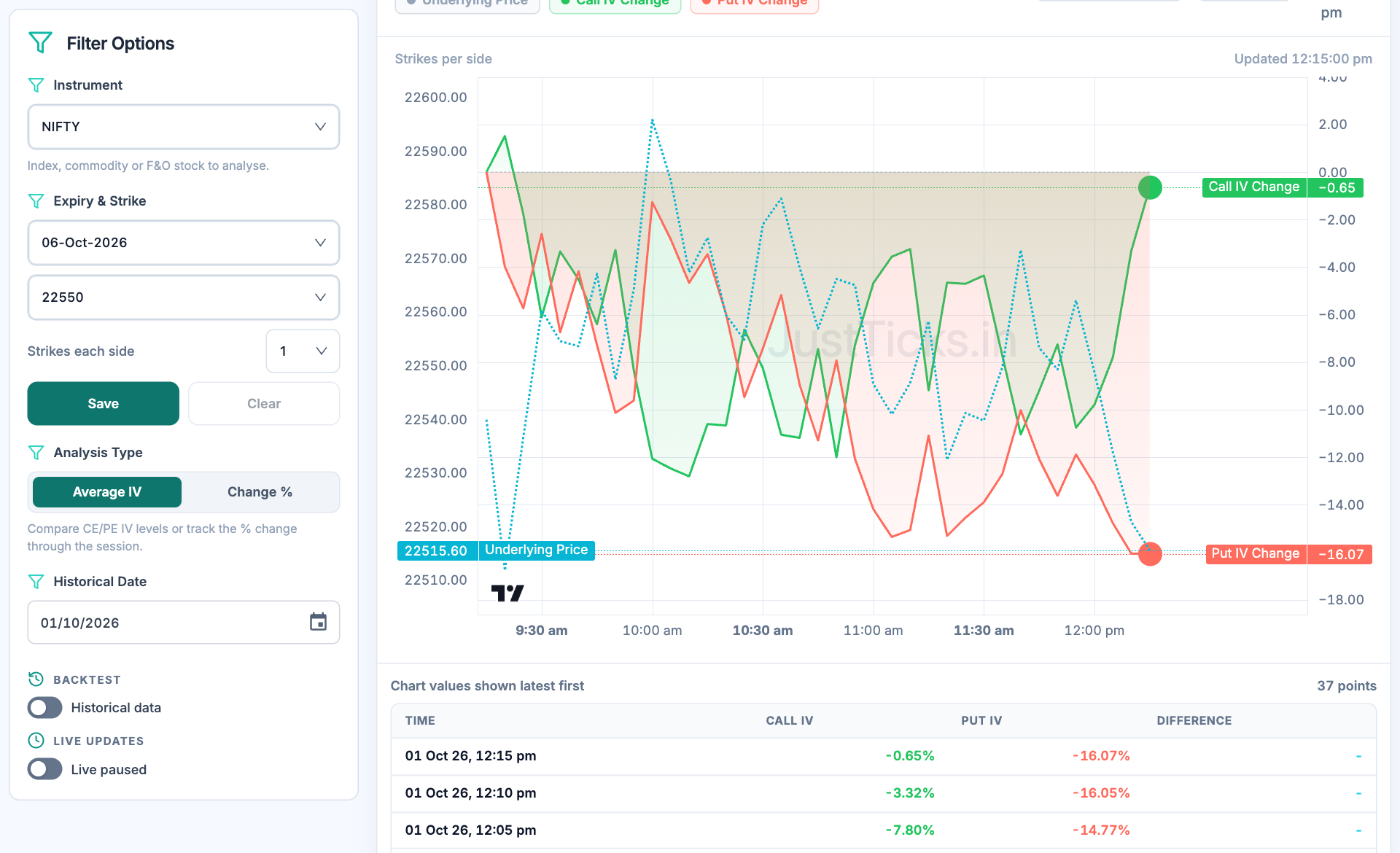
- Expiry and strike. Fix the expiry, center strike and window before comparing the call and put series.
- Level versus change. Choose the view, then verify its legend and units. The archived chart labels say IV Change.
- Matched observations. Compare the same timestamp and read underlying price on its separate scale.
- Snapshot table. Use the table to verify the call and put reading behind the plotted point.
- Open the Nifty IV chart or choose another supported instrument. Select the expiry, center strike and strike window.
- Choose Average IV for a level or Change % for relative movement. Read the axis and legend; a percentage change in IV is different from a change in percentage points.
- Keep the date and sampling interval consistent, then compare call and put series with price and the latest table.
- For a cross-instrument scan, open the IV screener. For premium sensitivity to IV rather than IV itself, use Vega Analysis.
For example, moving from IV 20% to 18% is a fall of 2 percentage points, or 10% relative to its starting value. A chart labeled change percent should not be read as an IV level of minus 10%.
Limits and common misreads
- Illiquid strikes. IV is calculated from a traded price. If a strike has not traded recently, its IV is stale and can mislead.
- Model dependence. IV comes from a pricing model, so inputs such as the interest rate and dividends change the reading slightly.
- High IV is not a signal by itself. It tells you premiums are rich compared with history, not that a position will make or lose money.
- Falling IV does not guarantee falling premium. A large favourable price move or rising gamma can outweigh it.
This guide is educational and is not investment advice.