
What delta exposure measures
Every open option contract carries a delta, and open interest tells you how many contracts exist. Multiplying delta by open interest, contract size and the index level gives the rupee value of directional exposure sitting at each strike. Summed across the chain and netted between calls and puts, it becomes net DEX.
DEX is a level: it describes the directional position the option book represents. It is modelled from open interest and live option deltas, not published by the exchange.
Customer view and dealer view
NSE does not publish who is long or short each contract, so any DEX figure rests on an assumption. In the customer view, calls add positive delta and puts add negative delta, as if the open interest were held by buyers. The dealer view flips the signs on the assumption that dealers are on the other side.
Real books include writers, hedged spreads and institutions that do not fit the assumption, so use the two views as lenses, not as facts about who holds what.
DEX vs GEX
| DEX | GEX | |
|---|---|---|
| Question answered | How much directional exposure does the option book carry? | How fast does that exposure change as price moves? |
| Role | The level of the position | The rate at which the position re-hedges |
| Use together | Direction and size from DEX | Regime and stability from GEX |
The delta neutral level
If you re-price the whole chain at different index levels, net DEX changes. The index level where net DEX crosses zero is the delta neutral level: below it the book leans one way, above it the other way. The Delta Exposure page draws this as a sweep so you can see how far spot is from the crossing and how steep the curve is.
Reading the Delta Exposure page
- Strike profile: call and put DEX bars with the net line; the largest bars mark the shelves where exposure is concentrated.
- DEX flow: the part of exposure that comes from fresh open interest, which separates new positioning from old.
- Heatmap: strike by time, to see whether exposure is migrating toward or away from spot.
- Delta divergence: compares spot with a net DEX flow proxy and flags when they disagree. It is a modelled proxy, not exchange trade-side data.
- Strike matrix: the same figures in a sortable table with the at-the-money strike marked.
How to use the Delta Exposure (DEX)
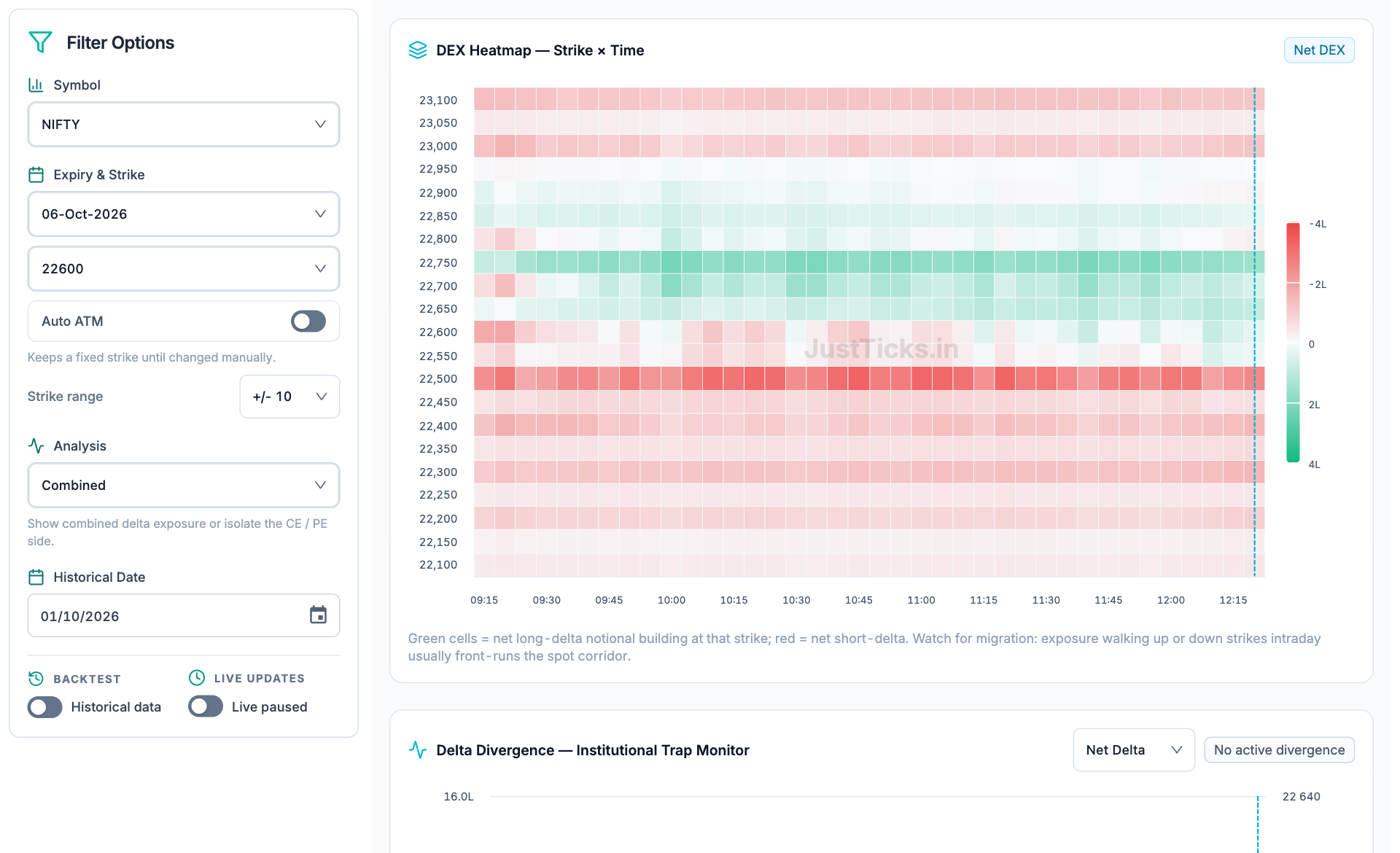
- Fixed or ATM selection. Auto ATM can change the selected reference strike as price moves.
- Combined versus side. Combined, CE and PE views aggregate different covered inputs.
- Strike by time. Follow a row through time to inspect changes at one strike.
- Signed legend. Read the sign and scale from the legend; colors alone do not identify actual holders.
- Choose instrument, expiry and session, then fix the strike window.
- Read the selected customer or dealer convention and the signed units. Exposure is modeled rather than observed ownership.
- Compare the strike profile with the heatmap to see whether concentrations persist or migrate.
- Inspect the neutral-level sweep separately. A crossing is a model output, not a calibrated price target.
Limits and common misreads
- Positioning is assumed, not observed. If the real holders differ, the signs differ.
- Net DEX can be positive while price falls. It is a level, not a forecast.
- Thin chains are noisy. Stock options with little open interest give unstable deltas.
- Events override structure. Gaps, policy days and results can change the picture quickly; refresh and check the timestamp.
This guide is educational and is not investment advice.