
Are insider trading disclosures illegal insider trading?
No. Illegal insider trading means trading on unpublished price-sensitive information. The disclosures shown here are the opposite: trades by promoters, directors, key managerial personnel and designated persons that the rules require them to make public. Under the SEBI (Prohibition of Insider Trading) Regulations, 2015 a trade above a value threshold must be reported to the company, which informs the exchange within a short deadline. At the time of writing the threshold is ₹10 lakh of traded value in a calendar quarter and the company reports within two trading days. Check the regulation text for current limits.
What the filings contain
| Field | What it tells you |
|---|---|
| Person category | Promoter, promoter group or director |
| Acquisition mode | Market purchase, market sale, pledge, ESOP, off-market transfer |
| Securities and value | Number of shares and the value of the trade |
| Transaction dates | When the trade happened and when it was reported |
| Holding before and after | Shareholding percentage change from the trade |
The trade date and the report date differ. Always read the trade date when you judge timing.
How to read net insider flow
- Net flow is the value of market purchases minus market sales for a company in the selected window. Positive means insiders were net buyers.
- Average price is the weighted average price on the winning side. If insiders net bought, it is their buying average; if they net sold, their selling average. Netting buys against sells would give a meaningless price.
- Price edge compares the current price with that average. A positive edge means the stock now trades above the insiders' average price.
- Size versus market cap shows how large the net value is relative to the company. ₹10 crore is material for a ₹500 crore company and trivial for a large cap.
- Prints count the separate disclosures. Several insiders trading the same way is more informative than one filing.
JustTicks counts a re-published filing once and leaves out rows whose implied price is far from the market price, which are usually reporting errors.
Why insider sales and purchases mislead
- Sales are often personal. Taxes, loans, diversification, estate planning and ESOP exercises explain many sales and say little about the business.
- Purchases can be mechanical. Promoters raising their stake under creeping-acquisition limits or after a preferential allotment are not necessarily making a view.
- Pledges and transfers are not market trades. Counting them as buying or selling distorts the picture, so the net flow here uses market purchases and sales only.
- Disclosure lags the trade and the stock may already have moved.
Read the original filing and the company's announcements alongside the numbers. Nothing here is investment advice.
How to use the Insider Trading Screener
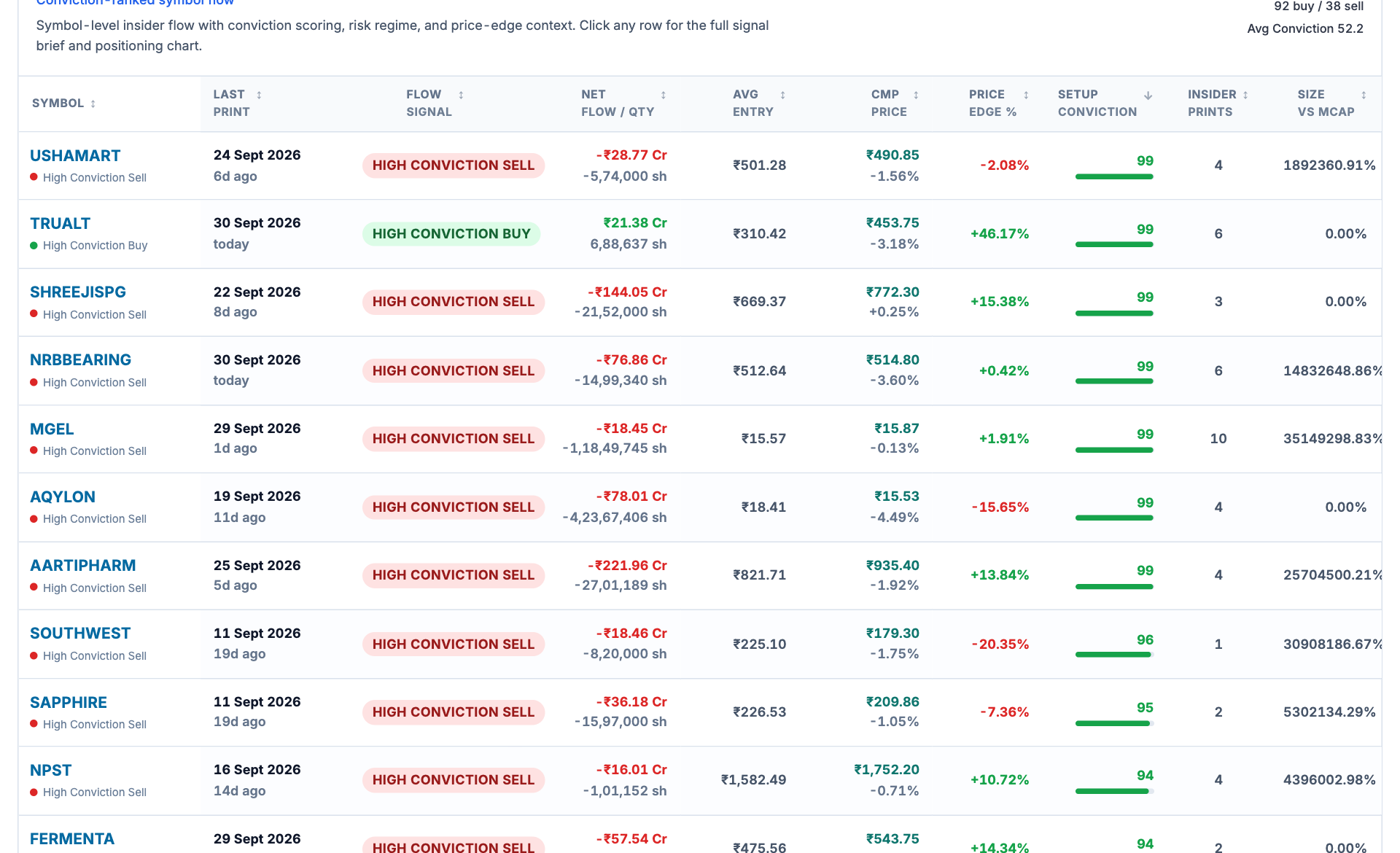
- Disclosure date. Read the last-print date; a report date can differ from the underlying trade date.
- Net flow. The row summarises the selected disclosure window, not an order available to execute now.
- Price edge. The comparison uses current price versus the reported average, so it is retrospective.
- Conviction score. The tool ranking is a heuristic, not a calibrated probability.
- Choose the reporting window and company or participant filters in the tool.
- Read transaction mode and original disclosure before interpreting a net-buy or net-sell label.
- Compare net flow, average price, print count and size context; flag implausible values for verification.
- Open the company detail and check the reported trade dates against its price history.
Read a numerical example
Suppose disclosed market purchases total ₹12 crore and market sales total ₹5 crore for a company in the selected window. Net flow is +₹7 crore. Pledges and off-market transfers require separate treatment and should not be added as though they were market purchases.
Illustrative arithmetic only; this is not a current signal or a trade recommendation.