
What is a bulk deal, and how is it different from a block deal?
A bulk deal is reported when the total quantity a client buys or sells in one stock in a day is more than 0.5% of the company's listed shares. It can be built from many small trades across the session, so it does not have to be a single large order.
A block deal is a large trade executed through a separate exchange window under its specified pricing rules. The NSE member FAQ published in December 2025 sets the minimum order size at ₹25 crore. Block deals are distinct from the day-total bulk disclosure threshold. Check the NSE block-deal session FAQ for the current operating rules.
| Bulk deal | Block deal | |
|---|---|---|
| Trigger | Day total above 0.5% of listed shares | One trade above the minimum size |
| Execution | Normal market session, any number of trades | Separate block window, single trade |
| Disclosure | Client name, side, quantity, average price | Client name, side, quantity, price |
| Published | After market close | After market close |
What the disclosure contains
Each record lists the date, symbol, client name, whether the client bought or sold, the quantity and the weighted average price. Both sides of a trade can appear: a fund selling a block and another fund buying it show up as two rows.
Disclosure arrives after the session. It tells you what already happened and who was involved. It does not show live orders or what the client plans to do next.
How to read buyers and sellers
Client names are free text, so grouping them takes judgement. JustTicks classifies each name into FII, DII, mutual fund, insurance, PMS or AIF, promoter, and proprietary or HNI desk using name patterns. This is a heuristic: a name can be misclassified, and a related-party transfer can look like institutional flow.
- Participant type tells you who is trading. A ₹50 crore print from a mutual fund and from a proprietary desk are different information.
- Size relative to the stock's volume matters more than the rupee amount. A ₹20 crore print in a thinly traded small cap is large; in a Nifty heavyweight it is routine.
- Both sides of the same deal often appear together. Check whether the seller and buyer are related before treating it as accumulation.
Single prints versus repeated prints
One large print is easy to over-read. The same client appearing on the same side in the same stock across several sessions is a stronger pattern, because it points to a position being built or reduced over time rather than a one-off transfer.
The JustTicks scanner counts repeat prints per client and symbol, tracks the symbol net flow (disclosed buying minus selling in the selected range) and combines these with the print's size percentile and the participant type into a 5 to 99 conviction score. The score ranks prints inside the selected window. It is a way to sort the list, not a forecast.
Limits and common misreads
- A bulk deal is not a signal by itself. Reasons for a trade include portfolio rebalancing, index changes, redemptions, negotiated transfers and open offers.
- Disclosure lags the trade. Price may already have moved by the time the data is published.
- Only large trades appear. Smaller institutional activity below the 0.5% rule is not disclosed here.
- Names are not always unique. The same fund can trade under different scheme or account names.
Cross-check a print against shareholding patterns, announcements and the price chart before drawing any conclusion. Nothing here is investment advice.
How to use the Bulk Deals Scanner
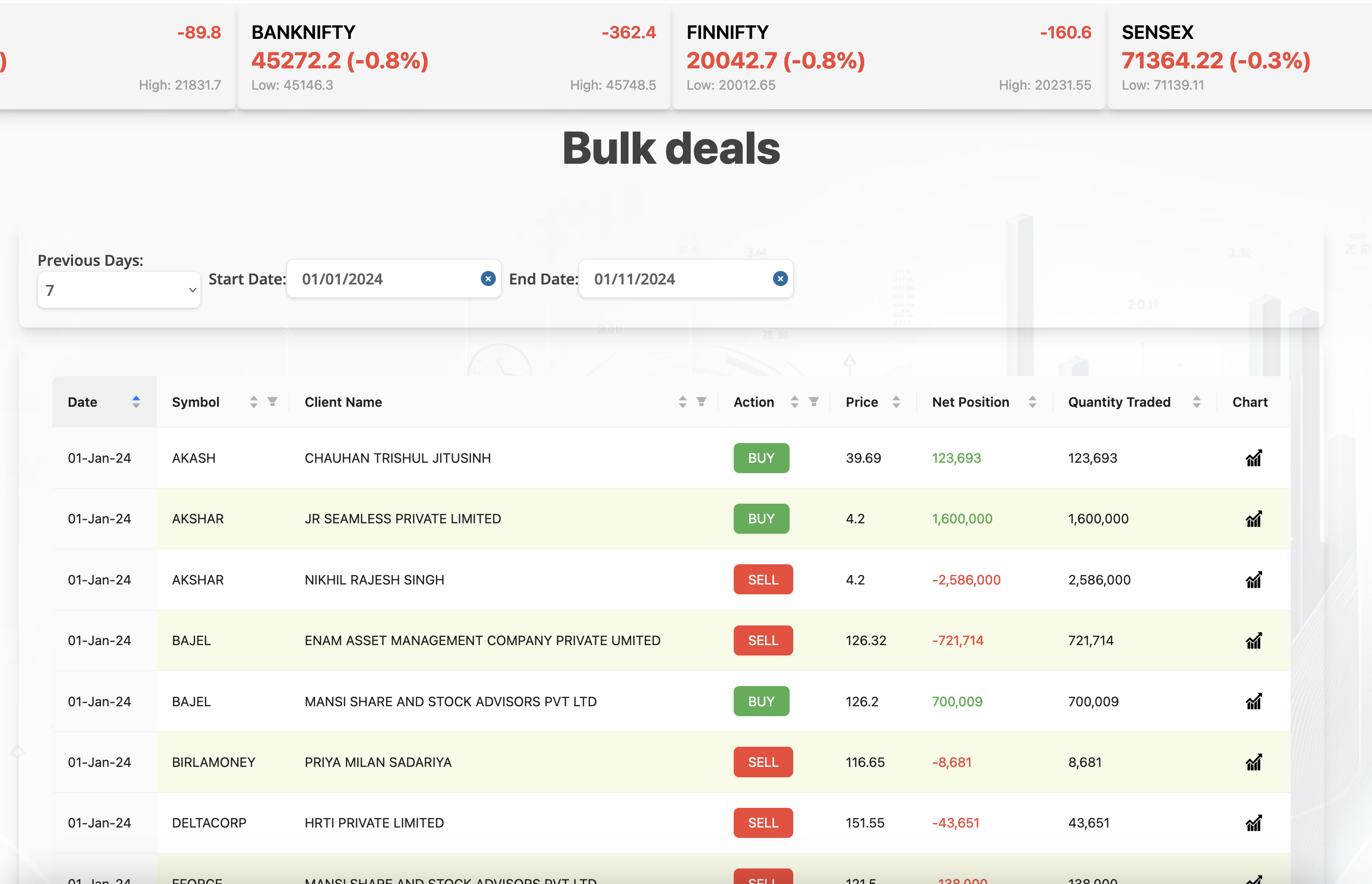
- Date range. Choose the report window before counting repeated client prints.
- Client identity. Read the disclosed name; participant classifications are inferred from names.
- Buy or sell. The side refers to the named client in this disclosure.
- Quantity and price. Read disclosed size with the stock liquidity and price context.
- Choose a session or date range in the Bulk Deals tool.
- Read the disclosed client, side, quantity and average price before using any derived ranking.
- Check for repeated client-symbol prints and whether buys and sells offset within the range.
- Open the stock chart and verify significant disclosures against the original exchange record.
Read a numerical example
If one client buys 1 lakh shares and sells 40,000 shares within the selected window, its disclosed net quantity is +60,000. That summary does not establish the client entire holding or expose any derivatives hedge.
Illustrative arithmetic only; this is not a current signal or a trade recommendation.