
What VWAP is and how it is built
Volume weighted average price (VWAP) is the running average of price across the session, with each price weighted by the volume traded at it. It starts fresh each day, so it describes where the day's average participant transacted.
A typical-price version averages each candle's high, low and close (HLC3) before weighting by volume. Different platforms use slightly different price inputs, so a value can differ by a few paise between charting tools; compare readings from one source.
- Price above VWAP: the average buyer today is in profit; dips tend to find support.
- Price below VWAP: the average buyer today is under water; rallies tend to meet selling.
- VWAP flattens as the session grows, so it matters most from mid-morning onward.
Screenshot: controls and readings
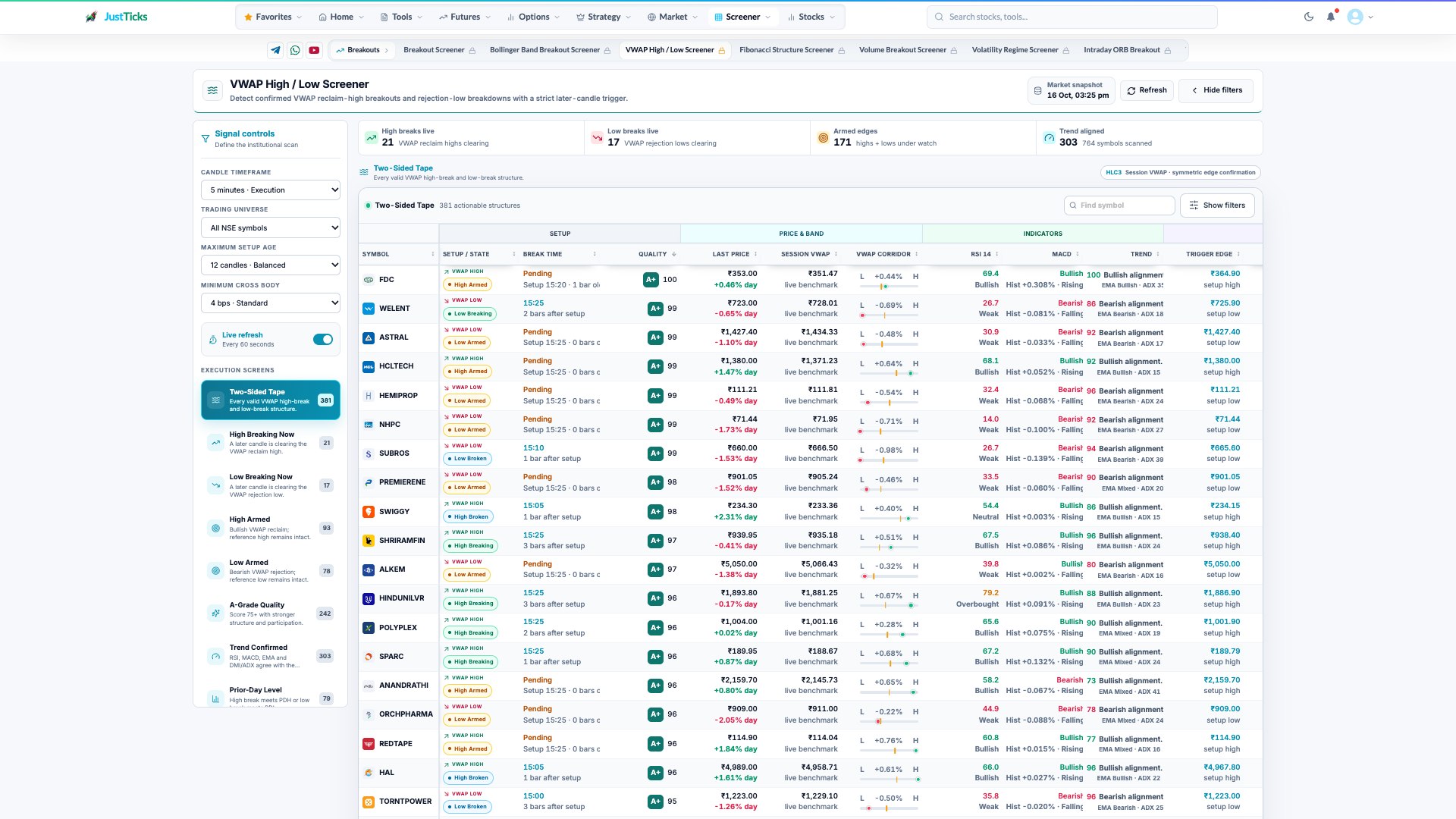
- Candle interval. A reclaim or rejection is evaluated on the selected candle interval.
- Setup state. Armed, breaking and broken describe different stages; read the setup and break time together.
- Session VWAP. Compare last price with the session benchmark, not with an assumed fixed support line.
- Trigger edge. The setup high or low is a separate reference from VWAP.
How to use the VWAP High / Low Screener
- Open the VWAP High / Low Screener and choose the timeframe and universe.
- Choose High Armed or Low Armed to inspect the reference reclaim/rejection candle.
- Compare armed rows with High Breaking Now or Low Breaking Now: a later candle must clear the reference extreme.
- Read setup RVOL, signal state and invalid level together. A quality score ranks conditions, not the probability of profit.
- Use the chart to verify the VWAP cross and later confirmation; a simple VWAP touch is a different event.
The two core setups
VWAP reclaim
BullishPrice trades below VWAP, then a strong candle closes back above it and the next candles hold. The reclaim suggests sellers lost control of the average.
VWAP rejection
BearishPrice rallies into VWAP from below, fails to close above it and rolls over. VWAP acts as the ceiling where trapped buyers sell.
A two-stage reclaim is stricter than a single cross: first a bullish candle that closes above VWAP, then a later candle that confirms by trading beyond the first candle's high. The second stage filters one-candle pokes that fall straight back.
Managing the trade
- Entry on the confirmation candle, or on a pullback to VWAP that holds.
- Invalidation is a close back through VWAP against the trade. The closer the entry is to VWAP, the tighter that stop.
- Targets use prior day high or low, the opening range edge or a fixed risk multiple.
- Filter by distance. A stock already 2% from VWAP has little room left for a clean stop.
VWAP resets every session and changes with every trade, so it is a moving reference, not fixed support or resistance. Compare readings at similar times of day.
A worked example
XYZ opens at 500 and drifts to 494. By 11:00 VWAP is 497. A candle closes at 498.5 above VWAP, and the next candle trades above that candle's high of 499 and holds. Entry 499.2, stop on a close back below VWAP at 497, so risk is about 2.2.
If the target is the previous day's high at 505, reward is 5.8, roughly 2.6R (5.8 ÷ 2.2). If the same stock were already at 506 when you noticed, the stop 9 points away would give a poor ratio.
Illustrative numbers for a hypothetical stock, not a recommendation or a past trade.
Why VWAP signals fail
- Range days. Price crosses VWAP repeatedly in a sideways session; each cross is noise.
- Low volume. VWAP drifts toward price when few shares trade, so a reclaim means little.
- First 30 minutes. VWAP is dominated by the opening burst and has little history.
- Ignoring the trend. A reclaim against a strong downtrend on the index fails more often.