
Spike or momentum?
| Feature | Sustained mover | One-off spike |
|---|---|---|
| Source of the move | Builds over several candles | One candle, a gap or a single print |
| Volume | Elevated through the move | Concentrated in one candle |
| Liquidity | Liquid, tight spreads | Thin, wide spreads |
| After the move | Holds above the breakout level | Gives it all back quickly |
| Context | Sector or index moving too | Isolated, no news |
Screenshot: controls and readings
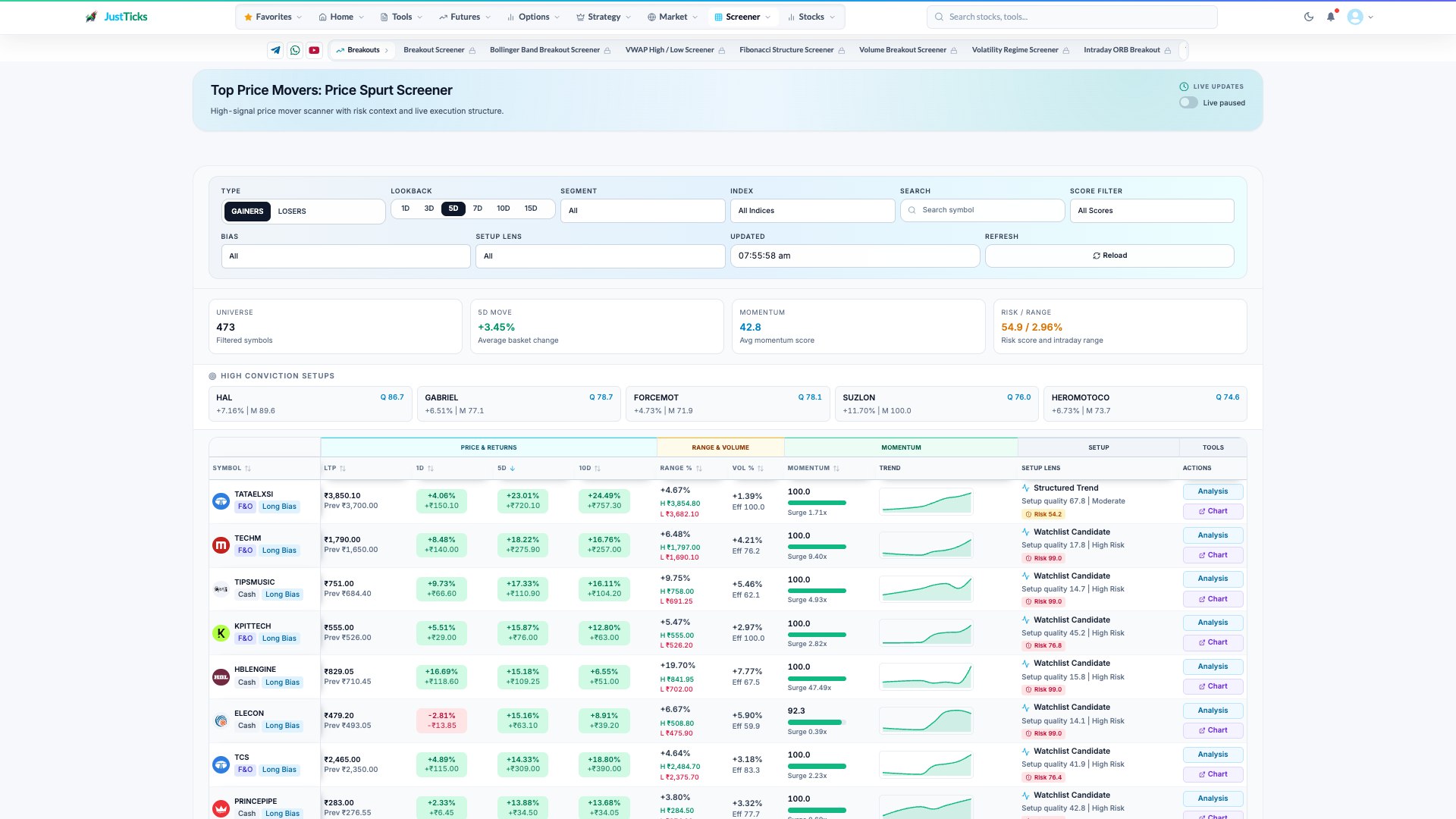
- Lookback. The selected five-day return is a different question from the one-day move.
- Universe. Apply segment and index filters before interpreting a ranked result.
- Return columns. Compare like-for-like periods and inspect the corresponding price range.
- Setup context. The setup lens and risk annotations are diagnostics, not guaranteed outcomes.
How to use the Top Price Movers
- Open Price Spurt, choose segment or index scope and confirm the market timestamp.
- Sort a consistent price-change or momentum measure across the list.
- Compare the selected movement window with volume, range and risk labels.
- Open the chart for one symbol to check whether the move is sustained or mostly a gap.
- Cross-check unusual participation in Volume Breakout; a price move and a volume spike are separate observations.
Checks before acting
- Measurement window. Know whether the percentage is from the previous close or from a short interval; they answer different questions.
- Gap or move? A stock that opened up 8% and traded flat has not moved intraday.
- Follow-through. Does price hold above the level it broke, or does each candle fade?
- Liquidity and sector. A mover supported by its sector is more reliable than a lone name.
- Corporate actions. Splits and bonus issues can show a large apparent change in unadjusted data.
A worked example
Two stocks are both up 6%. Stock A gapped up 6% at the open and has traded flat since. Stock B built its 6% over 90 minutes, pulled back three times without losing VWAP, and its sector is up 2%.
A has made no intraday move at all. B shows follow-through, support and sector agreement. Only B belongs on a momentum watchlist, and it would be entered on a pullback, not at the day's high.
Illustrative numbers for a hypothetical stock, not a recommendation or a past trade.
Risk and entries
The best-priced entry on a mover is rarely the one at the top of the gainers list. Wait for a first pullback that holds a recent level, size from the stop distance, and expect slippage in volatile names. A mover that cannot hold its gains after the first push is a poor candidate at any price.