
What a fair value gap is
Take three consecutive candles. If the first candle's high is below the third candle's low, price moved so quickly through the middle candle that a gap remains between them where little or no trading took place. That gap is a bullish FVG. The mirror, where the first candle's low is above the third candle's high, is a bearish FVG.
| Type | Condition | Zone |
|---|---|---|
| Bullish FVG | Candle 1 high is below Candle 3 low | From Candle 1 high to Candle 3 low |
| Bearish FVG | Candle 1 low is above Candle 3 high | From Candle 3 high to Candle 1 low |
Screenshot: controls and readings
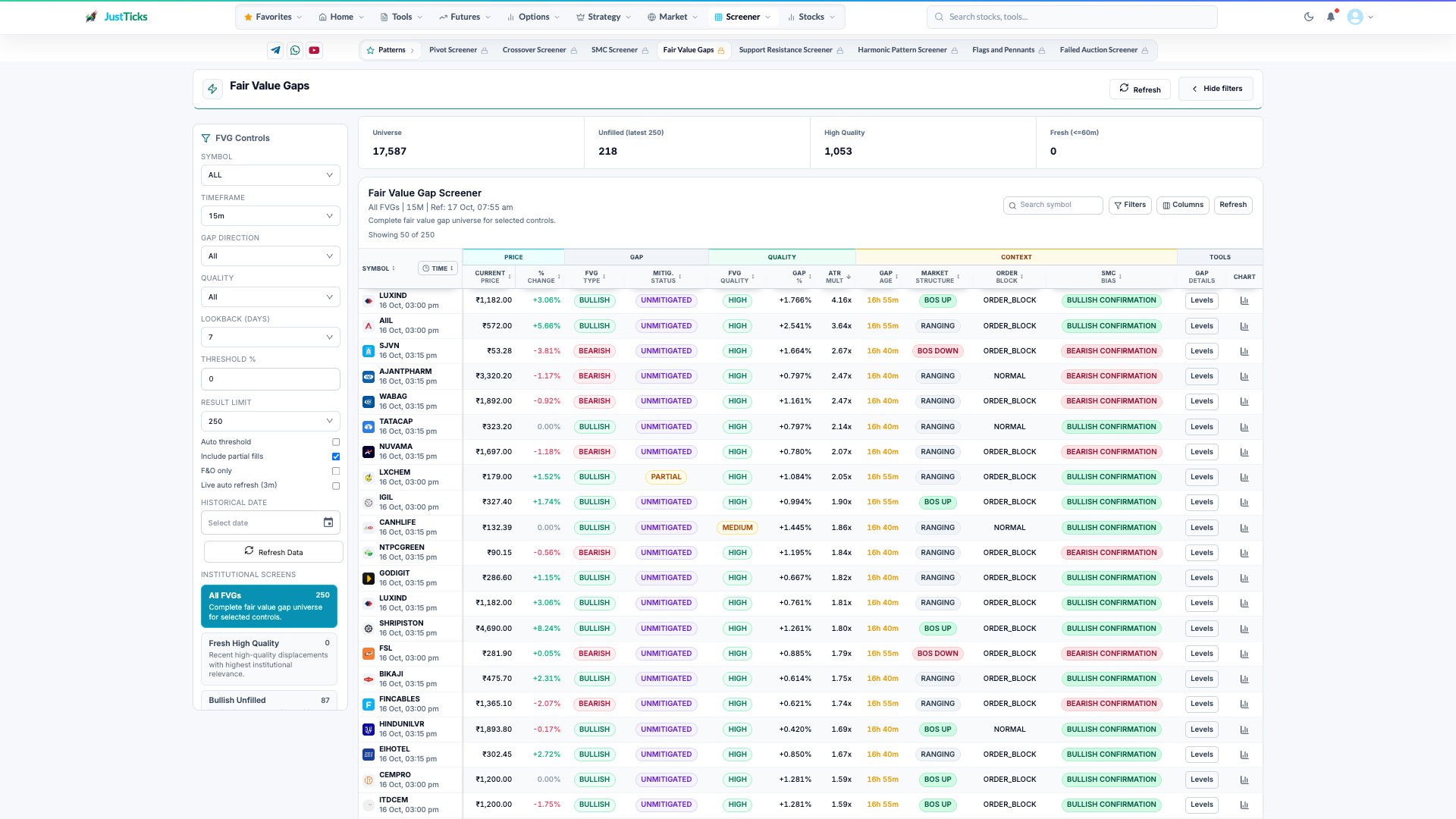
- Timeframe. Gap structure belongs to the selected candle interval.
- Mitigation state. Unmitigated and partial describe how much of the gap has been revisited.
- Quality and size. Quality, gap percentage and ATR multiple provide different context.
- Structure context. Market structure and order-block labels are model classifications, not proof of participant intent.
How to use the Fair Value Gaps Scanner
- Open Fair Value Gaps and match timeframe, date and universe.
- Separate bullish and bearish gaps, then select unfilled or partly mitigated zones.
- Read both gap boundaries, its age and fill status; a gap label is not an obligation for price to return.
- Compare displacement and volume with the three candles that formed the gap.
- Recheck the lifecycle after later candles trade into the zone; a fully filled gap is a different observation from an unfilled one.
How traders use it
The working theory is that a fast, one-sided move leaves unfilled orders, so price is often drawn back into the zone before continuing. Traders therefore watch three behaviours:
- Fill: price returns into the gap, partly or fully.
- Reaction: price reverses inside or at the edge of the zone, treating it as support (bullish) or resistance (bearish).
- Invalidation: a candle closes through the whole gap, meaning the zone failed.
Gaps on higher timeframes carry more weight than on lower ones, and a gap that forms with a break of structure is generally preferred to one in a flat range.
A worked example
Three candles: the first has a high of 100, the second rallies strongly, the third has a low of 104. The bullish FVG is the zone 100 to 104. Later, price pulls back to 103 and a candle closes at 104.5.
Entry 104.5, stop 99.5 beyond the far edge of the gap (risk 5), target the recent high at 112 (reward 7.5): 1.5R. A close below 100 means the gap failed and the idea ends.
Illustrative numbers for a hypothetical stock, not a recommendation or a past trade.
A cautious routine
- Pick a timeframe and filter by direction that matches the trend.
- Prefer unfilled, recent zones; old, partly filled zones are weaker.
- Wait for a reaction candle at the zone instead of buying the first touch.
- Place the stop beyond the far edge of the gap; a close through it invalidates the idea.
An FVG is a chart-defined imbalance, not an order-book measurement and not an obligation for price to return. Many gaps never fill, and filled zones do not have to hold.